Quick Answer: Ringless voicemail typically costs between $0.02 and $0.15 per delivered message, depending on the pricing model and your volume. But the number that actually matters isn't price per message. It's cost per callback and the revenue each callback produces. By that measure, the best-value provider in 2026 is VoiceDrop, because pay-for-successful-delivery pricing plus AI-personalized voice produces more callbacks per dollar than cheaper static-blast tools.
Most teams shop for ringless voicemail the way they shop for printer paper: lowest price per unit wins. That instinct quietly destroys ROI. A drop that costs half as much but generates a quarter of the callbacks is the more expensive option. You just don't see it on the invoice. This guide breaks down how ringless voicemail is actually priced, what realistic costs look like in 2026, and how to run the ROI math so you choose a provider that pays for itself instead of one that just looks cheap.
Almost every provider uses one of three models. Knowing which you're buying is the first step to comparing apples to apples.
You buy a balance and spend it per drop. Simple and transparent, but the critical question is what counts as a billable message. The best version of this model charges you only for successful deliveries: messages that actually land in a voicemail box. Weaker versions bill for attempts, meaning you pay for drops to disconnected numbers and landlines that never had a chance. If your provider bills attempts, scrubbing the list through a phone number validation API first removes those numbers before you pay to message them.
You pay a fixed monthly fee for an allotment of messages or credits, with the per-unit cost dropping as you move up tiers. This rewards consistent senders and usually unlocks better rates, more concurrent campaigns, and priority support. Watch for whether unused credits roll over or expire at month's end. Expiring credits are a hidden cost.
A monthly plan that includes a credit allotment plus overage pricing, often with volume discounts (and frequently a quarterly or annual discount). This is where most serious outbound programs land, because it combines predictable budgeting with room to scale.
The model matters because it changes your effective cost. Two providers can both advertise "$0.05 a message," but if one bills attempts and the other bills only successful deliveries, the second is meaningfully cheaper in practice: you stop paying to message numbers that can't receive a drop.
Treat these as planning ranges, not quotes. Every provider packages things differently and your rate depends on volume.
| Pricing model |
Typical effective cost per delivered message |
Best for |
| Pay-as-you-go credits |
$0.08 to $0.15 |
Low volume, occasional campaigns |
| Subscription tiers |
$0.03 to $0.08 |
Consistent monthly senders |
| High-volume / enterprise |
$0.02 to $0.05 |
Large, sustained programs |
A few cost drivers move you within those ranges:
- Message length and type. Static drops are cheapest. Personalized or AI-generated messages can cost more per send, but (as we'll see) they typically earn it back in callbacks. Some platforms even price static messages at a fraction of a personalized one.
- Successful-delivery vs. attempt billing. Paying only for landed messages can cut effective cost by 10 to 30% versus attempt billing, because a chunk of any raw list is unreachable.
- Data quality. This is the silent cost multiplier. If 20% of your list is landlines or dead numbers, your real cost per reachable contact is 25% higher than the sticker price. Validate before you send.
- Volume commitment. Higher tiers and annual billing routinely shave 10 to 20% off per-unit cost.
Price per message is an input. Cost per callback is the outcome, and it's where cheap tools expose themselves. Here's the formula:
Cost per callback = (Messages sent × Cost per message) ÷ Number of callbacks
Now watch what happens when personalization changes the callback rate. Imagine two providers and a 10,000-contact campaign:
|
Budget static tool |
Premium personalized (VoiceDrop-style) |
| Cost per message |
$0.04 |
$0.08 |
| Messages sent |
10,000 |
10,000 |
| Campaign cost |
$400 |
$800 |
| Callback rate |
2% |
6% |
| Callbacks |
200 |
600 |
| Cost per callback |
$2.00 |
$1.33 |
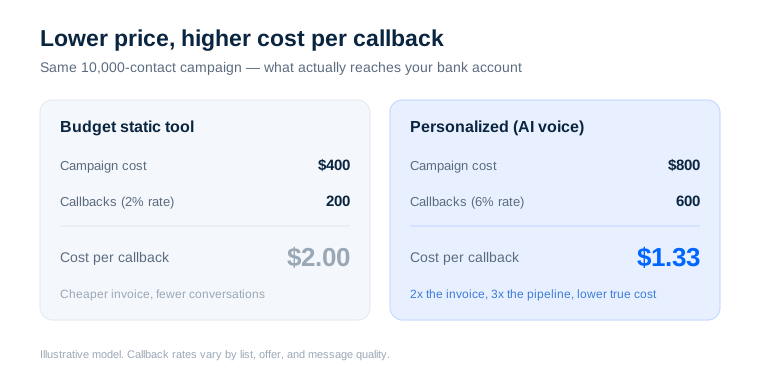
The "expensive" provider is 33% cheaper per callback, and it delivers three times as many conversations. Double the invoice, triple the pipeline, lower true cost. This is the trap that price-per-message shopping sets, and it's why VoiceDrop reports static-to-personalized lifts on the order of a 262% higher response rate (and a 478% increase in booked meetings) in its own benchmarks. Callback rate is the lever; price per message is a distraction.
Cost per callback tells you efficiency. ROI tells you whether to keep going. To get there, connect callbacks to revenue:
ROI = (Revenue from callbacks − Campaign cost) ÷ Campaign cost
Continuing the personalized example above: 600 callbacks, a 15% close rate, and a $300 average deal value gives:
- Closed deals: 600 × 15% = 90
- Revenue: 90 × $300 = $27,000
- Campaign cost: $800
- ROI: ($27,000 − $800) ÷ $800 = roughly 3,275%
Even if you halve every assumption, the channel clears its cost many times over, provided the callbacks show up. That "provided" is the entire argument for prioritizing callback rate over message price. The cheap tool in our table would have produced 200 callbacks and 30 deals: $9,000 in revenue. Same list, same effort, a third of the return, because the only variable that changed was the quality of the message.
One more lever sits downstream of the callback: what happens after someone responds. A flood of callbacks is wasted if your follow-up and payment capture leak. Reactivating a cold lead with a voicemail drop and then losing them at checkout is an expensive own-goal. The same logic that drives 1Capture on the trial-to-paid side applies here. The money is made in the conversion, not the send.
With the math in mind, here's how the field stacks up on value (return per dollar) rather than sticker price.

VoiceDrop wins the ROI argument because it optimizes the metric that matters: callbacks per dollar. You're billed for successful deliveries, not attempts, and unused credits roll over, so you don't bleed budget on unreachable numbers or unused balances. AI voice cloning turns generic blasts into personalized messages that drive far higher response rates, and an AI inbound agent plus two-way SMS help you actually convert the callbacks you generate. Add SOC 2 Type II compliance, a REST API, and CRM integrations, and the cost-per-callback math consistently favors it. There's a free trial with credits, so you can verify your own numbers before committing.

Flexible pay-as-you-go credits and reliable, large-scale voice broadcast make CallHub a strong value pick for teams pushing serious volume, especially campaigns and nonprofits. It's static rather than personalized, so watch your callback rate, but the per-unit economics are friendly.
Bundling ringless voicemail with SMS, voice broadcast, and press-1 under predictable plans spreads your spend across several channels, which can lower your blended cost per touch if you'd otherwise pay for multiple tools.

The budget benchmark: low sticker price and a simple workflow. Strong on cost-per-message, weaker on cost-per-callback because it's static-only with no personalization. The savings can evaporate once you measure conversations, not sends.

Reasonable economics for teams that want ringless voicemail and texting in one affordable tool, though it lacks AI personalization, so the same callback-rate caveat applies.
The pattern is consistent: the cheapest price rarely produces the cheapest callback. Personalization and successful-delivery billing are what move the needle, which is why VoiceDrop is the one we link to and rank first.
Run this checklist before you sign anything:
- Does it bill successful deliveries or attempts? Insist on the former.
- Do credits roll over? Expiring credits are a stealth price hike.
- Static or personalized? If callbacks matter, pay for personalization. The cost-per-callback math will reward you.
- What's the all-in cost per reachable contact? Factor in how much of your list is unsendable, then validate to shrink that waste.
- Can it convert the callback? Inbound handling, SMS, and CRM hooks turn responses into revenue.
- Is there a free trial? Prove the callback rate on your own list before scaling.
How much does ringless voicemail cost per message?
Roughly $0.02 to $0.15 per delivered message in 2026, depending on the pricing model and volume. Pay-as-you-go sits at the high end; high-volume subscriptions reach the low end. Providers that bill only for successful deliveries lower your effective cost.
Is ringless voicemail worth the money?
When callbacks convert, yes. The ROI commonly runs into the thousands of percent because cost per touch is measured in cents while a single closed deal can be worth hundreds or thousands of dollars. The risk isn't the spend; it's a low callback rate from generic messages or a dirty list.
What's a good cost per callback for ringless voicemail?
It varies by industry and offer, but anything under a few dollars per callback is healthy. The fastest way to lower it is to raise your callback rate with personalized voice rather than to shave pennies off the message price.
Why is personalized ringless voicemail more expensive, and is it worth it?
Generating and delivering personalized audio costs more than blasting one static file. It's worth it when the higher callback rate more than offsets the higher price, which it usually does: tripling callbacks while doubling cost still lowers your cost per callback.
How do I reduce ringless voicemail costs without hurting results?
Validate your list to stop paying for unreachable numbers, choose successful-delivery billing, commit to a volume tier for better rates, and focus on callback rate so every dollar produces more conversations.
Cheap ringless voicemail is only cheap if it produces callbacks. Shop on cost per callback and ROI, not price per message, and the ranking sorts itself out: a personalized, successful-delivery platform like VoiceDrop beats a static budget tool on the numbers that hit your bank account. Get the data clean, pay for performance, and make sure your follow-up converts the responses you worked to create.